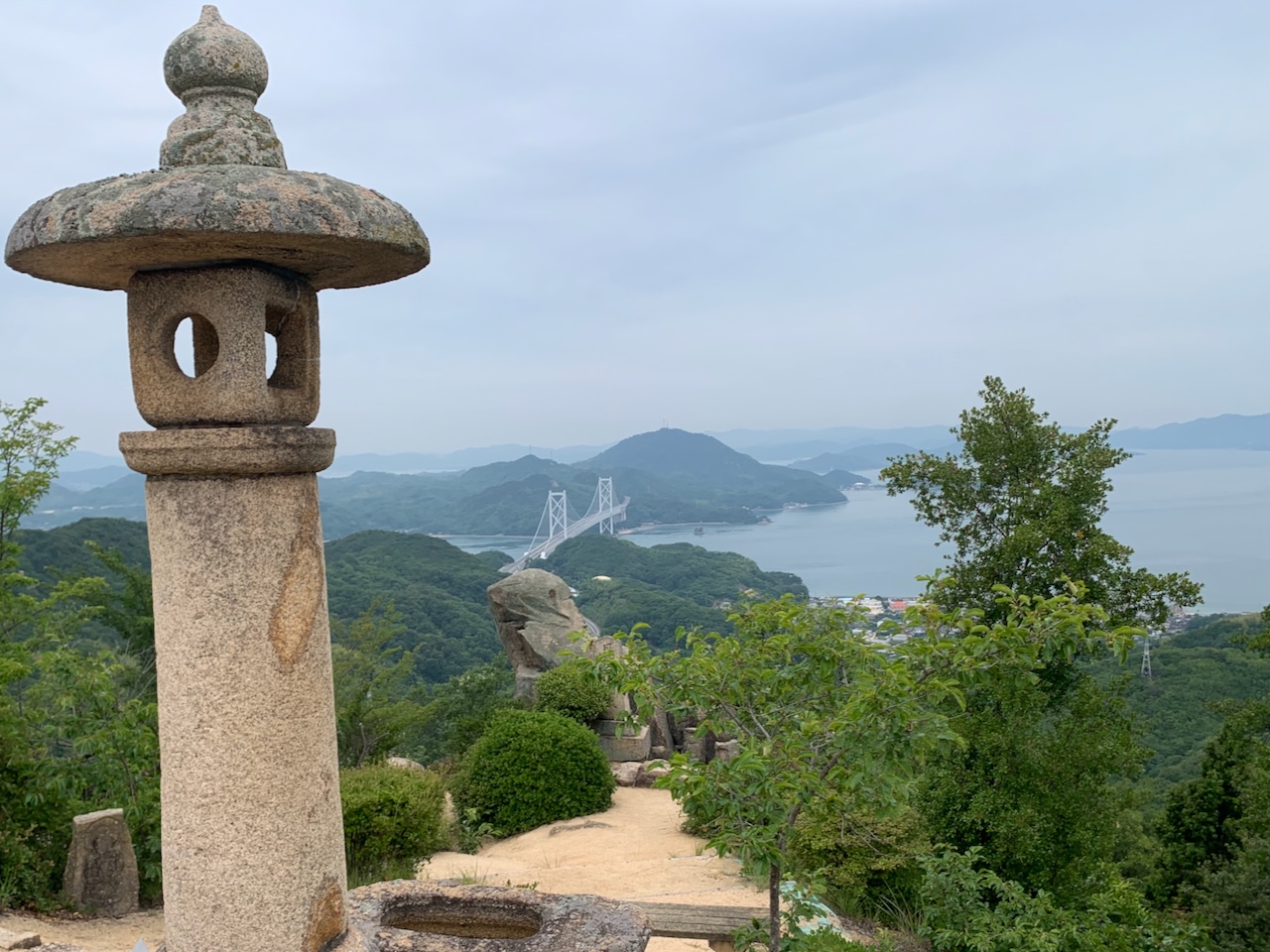
The Shimanami Kaido is often presented as one of Japan’s most beautiful and accessible cycling roads. It links Onomichi (Hiroshima Pref.), on the main island of Honshu, with Imabari (Ehime Pref.), on the island of Shikoku, across six islands in the Seto Inland Sea, connected by spectacular suspension bridges.
Those in a hurry will cover the 75 km in a day, making the most of the magnificent infrastructure and excellent signage. It is a fine sporting exercise, taking you through remarkable landscapes.
This time I had decided to slow the pace, make more detours and board ferries to discover a few of the outlying islands. This greatly increased the distance covered and elevation gain (I am always tempted to climb to the summits to enjoy the views). But it also allowed me to take the pulse of the region, which faces many challenges. It ceased to be a cycling story to become a case study of rural Japan’s future.
My stay at a beautiful and quiet village house on the island of Yuge, away from the usual itineraries, and close to a beautiful beach, was an invitation to taste “the peace of the gentle life of an islander”. But how sustainable is it, really? It was great to see that the island is home to a large technical college; you pass young people on bicycles or walking in groups, carrying soccer balls, kyudo archery bows or kendo gear, and could almost miss the challenge posed by the rapid population decline of the Shimanami islands, to which we will return. My exchange with the cordial house owner was enriching. A grower of nori, he has been hit head-on by changes in the environment of the Seto Inland Sea: the warming of the waters, perhaps +1 degree on average over 45 years, has been shortening the cultivation period and affecting the quality of the seaweed harvest. Nori production in Ehime waters declines faster than nationwide: official prefectural statistics show a fall of roughly 75% in fresh-weight production over 20 years. More recently, the low rainfall of 2025 and 2026 (at least until mid-June!), has worsened the depletion of nutrients in the sea: nitrogen, phosphorus, and silica, traditionally supplied by river water and runoff.
These same conditions, combined with “mechanical” higher salinity and lower oxygen levels, have placed enormous stress on oyster farms closer to Hiroshima, where mortality exceeded 80%, sometimes 90%, earlier this year, compared with 30 to 50% normally, apparently without parasitic or viral contamination. Fishing, my owner’s seasonal supplementary activity, and the islanders’ main pastime, is not productive enough either, due to the increasing scarcity of certain species in the food chain: maiwashi (sardines), ikanago (sand lance), shirasu (whitebait), shellfish (asari clams in particular) and others. Beyond the factors already mentioned, the dramatic reduction in eelgrass beds and tidal flats over a long period has unbalanced the ecosystem and deprived many fish species of food and spawning grounds.
About nutrients, we should not think, however, about returning to the agricultural and industrial practices of the 1970s and 1980s, which certainly contributed to high nitrogen levels in the waters, but also to many forms of pollution and contamination. On Honshu, initiatives have been launched to try to restore nutrients to the sea in a controlled way and repopulate it, with its flora and fauna: Onomichi Sea Nursery, Setouchi Oceans X, Hiroshima Bay Satoumi Network and others. Energetic as ever, my host is also setting himself new challenges, such as oyster farming, in cages rather than on ropes (the Hiroshima standard) for better control, or sea urchin farming. I will watch this space! A recent visit to Shodoshima, a little farther east, showed me that oysters can establish themselves and be farmed differently in Seto Inland Sea.
Riding the coastal roads around the islands reveals the archipelago’s main economic engine. While the hillsides and summits are green, and some islands are known for their citrus orchards, the shorelines are often industrial. You pass from a shipyard to another, or a metalworking workshop (the theme in Oshima is more stone quarries though). There are still beautiful preserved coves and beaches, but yes, Imabari-based or Imabari-located groups alone accounted for over 30% of Japanese shipbuilding activity around 2019, while Onomichi added another important maritime cluster (that includes islands). I understand that this sector represented an employment basin of nearly 20,000 people. On several occasions I was impressed by the size of the vessels in dry dock that suddenly appeared after a bend in the road, but some very quiet workshops also confirmed, anecdotally, the recent decline in tonnage under production. Against a backdrop of Asian competition, Japan’s new shipbuilding completions fell from about 19 million gross tons in the years around 2010 to 9 million in 2024, according to the Ministry of Land, Infrastructure, Transport and Tourism.
The phenomenon one cannot ignore when passing alongside shipping yards and the rows of small residential apartment blocks for employees is the strong presence of foreign workers, Asian in particular. A check of certain figures published by local Hello Work or Labour Bureau institutions suggests that foreign workers may account for a very large share of the shop-floor workforce in some yards and suppliers, sometimes plausibly in the 30-50% range. The community-based culture of the islands needs to adapt.
The overall population of these islands, meanwhile, continues to decline rapidly: between 20% and 40% over 25 years (ie -1% to -2% per year), depending on the island. It is sitting around 65,000 people today, or about 280,000 if one includes the cities of Onomichi and Imabari. It shows that the completion of the bridges connecting islands to Shikoku or Honshu was not enough to halt or reverse the trend! I nevertheless visited an acquaintance who, during Covid, made the family decision to leave Tokyo for a beautiful house they had built beside one of the small beaches on Oshima. Life has become remote work during the week, cultivation of their orchard and vegetable garden, and long drives across the region on weekends for their high-school-age son’s sports competitions. But how beautiful the sunsets are!
While this family had significant financial means, a visit to the Toyo Ito Museum of Architecture on the neighbouring island of Omishima revealed several initiatives intended to contribute to repopulation, or at least to anchoring the population. Toyo Ito designed an entire project of very economical small homes, integrating into their design the cultivation of a vegetable garden and/or orchard for subsistence. These homes struck me as a fine alternative to the corporate apartment blocks that house workers near shipyards. But the workers still need to have the means to stay and create families, visas included. While Omishima continues to loose population, there remains an inflow of newcomers each year.
In fact, the region’s other economic dynamic is, of course, tourism. The design of the Shimanami Kaido cycling experience is a real success. Visitor numbers, cyclists and non-cyclists alike, are growing rapidly. It is not easy to assess the total precisely, but some indicators are revealing: 173,000 public rental-cycle in 2025, and therefore a significantly higher total number of cyclists; 530,000 foreign visitors to Onomichi in 2024, compared with 340,000 in 2019. These visitors stimulate the creation of trendy cafés, restaurants and places to stay that are dedicated to them.
The main cultural theme being developed is that of the Murakami “pirates” – Murakami kaizoku – a clan that, for several centuries, ruled the Inland Sea and controlled its traffic from its dense network of forts, relying on its unique knowledge of the tides and of the labyrinth of islands, until it had to fall into line and become a full-fledged feudal clan under the domination of Toyotomi Hideyoshi and then the Tokugawa.
Yet the most impressive visit for me this time remains the Treasure Hall of the Oyamazumi Shrine on the island of Omishima. Although I am not especially versed in martial arts, I stood fascinated before the extraordinary blades and armours donated by great warriors who had come to thank the deity for their victories (many are listed as National treasures). Apparently only a small part of the collection is on display, but it includes a still very well-preserved suit of armour worn by Minamoto no Yoritomo, who imposed his political power in the twelfth century by defeating the Taira clan, and ruled as Shogun from the city of Kamakura, near Tokyo.
The Shimanami islands are gems. I left more knowledgeable, a little worried about the future of certain places, and wanting to bring more visitors who are willing to leave a positive local impact.